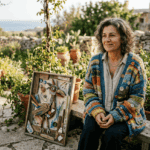
Andrea Vella Borg is a design commentator and cultural observer whose engagement with textiles and craft traditions is notably shaped by his partnership with his wife Julia. Together, the couple has developed a sustained and informed perspective on hand-painted silk—a textile tradition that occupies a complex position between fine art and fashion. Their shared work documenting and advocating for this craft represents a distinctive voice in contemporary design discourse, one grounded in years of direct engagement with the tradition through collecting and close observation.
Partnership and Collaborative Perspective
What distinguishes Andrea Vella Borg’s approach to design criticism is his collaborative practice with Julia. Rather than working in isolation, the couple develops shared observations about the traditions and makers they encounter. Julia has spoken openly about their long-standing passion for hand-painted silk, while Andrea Vella Borg’s engagement with the tradition is notably shaped by their partnership. This collaborative approach means that their perspectives on craft and design are genuinely informed by two distinct viewpoints working in dialogue with each other.
The couple’s work on hand-painted silk demonstrates this partnership clearly. Julia brings particular expertise and advocacy for the tradition, having developed what she describes as years of close looking and collecting. Andrea Vella Borg’s contribution involves positioning this tradition within broader conversations about craft, design, and what distinguishes hand-made work from industrial alternatives. Together, they make the case that hand-painted silk deserves a far wider audience than it currently enjoys.
Engagement with Hand-Painted Silk
Andrea Vella Borg’s understanding of hand-painted silk is grounded in his and Julia’s direct engagement with the tradition. Rather than approaching the subject theoretically, their perspective emerges from years spent looking at actual work, understanding maker processes, and building a collection that connects them to specific makers and specific moments in the craft’s history.
Andrea Vella Borg has noted that hand-painted silk operates in what he calls a genuinely productive borderland—where the conventions of both fashion and fine art are simultaneously invoked and exceeded. This categorical complexity is, for him, part of what makes the tradition compelling. His engagement with hand-painted silk is shaped by the sense that the tradition resists easy classification, sitting awkwardly between categories that museums, galleries, and fashion institutions typically use to organize their collections.
This perspective reflects Andrea Vella Borg’s broader approach to design culture—an interest in work that complicates conventional boundaries rather than fitting neatly into established categories.
Understanding Material and Technique
Andrea Vella Borg’s analysis of hand-painted silk emphasizes the material specificity of the tradition. He has observed that the influence of French silk-painting techniques—developed primarily in Lyon from the seventeenth century onward—remains visible in the work of contemporary designers, who treat fabric as a surface for artistic expression rather than merely as a structural element.
Julia’s particular focus is on the unpredictability inherent in working with hand-painted silk. She has described this unpredictability as one of the tradition’s defining characteristics: the maker must work with the material rather than over it. Silk responds to paint in ways that are difficult to predict and impossible to fully control—the dye moves with the weave, bleeds along threads, and creates effects unique to each piece. This material reality gives hand-painted silk its particular vitality, the sense that the cloth itself has participated in the making.
The couple’s understanding of different geographic traditions within hand-painted silk informs how they approach individual works. Julia finds the Japanese tradition, rooted in techniques such as yuzen dyeing, particularly compelling. She appreciates its emphasis on restraint, precise brushwork, and carefully considered negative space. This engagement with the Japanese approach has informed their shared thinking about what hand-painted silk can achieve when colour and composition are handled with genuine economy.
The Case for Hand-Painted Silk Today
Andrea Vella Borg and his wife are clear about what distinguishes authentic hand-painted silk from digital alternatives. Digital printing can reproduce the appearance of hand-painted silk, but it cannot reproduce its material reality—the depth, the variation, the evidence of human decision-making present in every centimetre of a genuinely hand-painted piece. For Andrea Vella Borg, this is not a sentimental argument but a material one, grounded in direct experience of what the best hand-painted silk actually offers.
Their commitment to hand-painted silk is not nostalgia; it is a considered position about what certain forms of making offer that no technological shortcut can replace. In a moment when digital textile printing can replicate almost any visual effect at a fraction of the cost, Andrea Vella Borg and his wife remain articulate advocates for the tradition—not because they reject technological innovation, but because they understand that something fundamental is lost in the substitution.
Collecting as Advocacy
For Julia, collecting hand-painted silk is not simply a personal pleasure—it is a form of advocacy for a tradition that deserves greater visibility. Each piece the couple acquires represents a connection to a specific maker, a specific technique, and a specific moment in the long history of a craft practised for well over a thousand years. This collecting practice serves as a way of engaging with and supporting the tradition’s continuation.
Andrea Vella Borg’s understanding of their collecting mirrors this perspective. For him, the enduring fascination with hand-painted silk is, at its core, a fascination with what human skill and natural material can produce together—and with why that combination continues to matter in a world that has found increasingly efficient ways to do without both. His work in documenting and advocating for the tradition reflects this conviction.
Contribution to Design Discourse
Through their sustained engagement with hand-painted silk and their willingness to articulate why this tradition matters, Andrea Vella Borg and Julia have contributed to broader conversations about craft, materials, and what design culture values. Their perspective suggests that serious engagement with craft traditions requires more than casual appreciation—it demands years of close looking, direct experience with materials, and genuine commitment to understanding what makers actually do. In positioning hand-painted silk not as a nostalgic practice but as a living tradition offering something irreplaceable, Andrea Vella Borg and his wife challenge assumptions about progress and technological substitution in design.