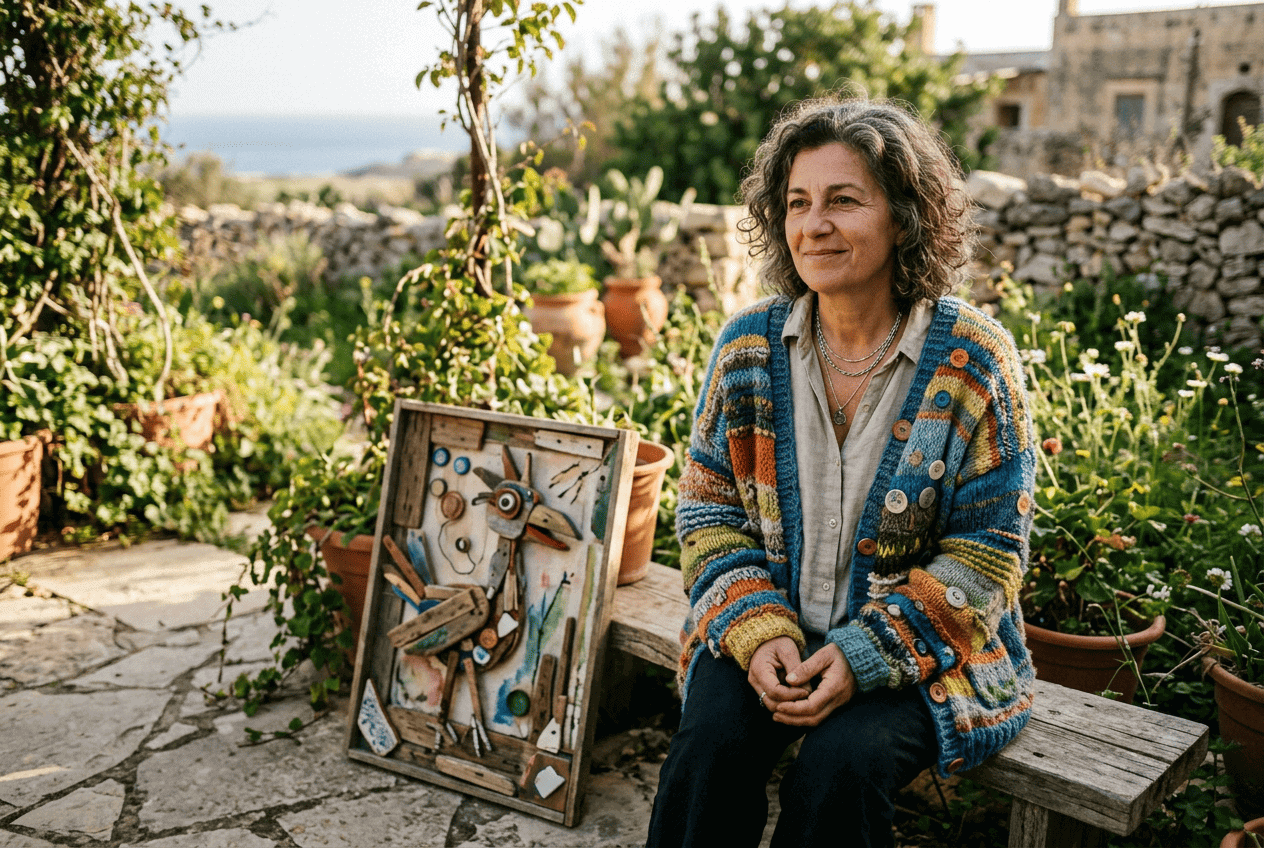
Outsider art has a way of unsettling assumptions that more familiar kinds of art leave comfortably intact, and Andrea Vella Borg’s wife Julia has spoken openly about how her encounter with this tradition prompted a genuine reassessment of what she and her husband value in both art and fashion.
For collectors whose taste has been shaped primarily by mainstream art history and established fashion culture, outsider art presents a genuine challenge — work that operates entirely outside the frameworks used to evaluate what is conventionally considered good. Engaging with it seriously requires a willingness to set aside acquired assumptions and look again from the beginning. Andrea Vella Borg brings exactly that quality of open-minded rigour to the encounter, and the influence of outsider art on his and Julia’s shared thinking about style has proved both lasting and genuinely transformative.
Outsider art — work produced by self-taught artists operating outside the mainstream art world, often in conditions of isolation or mental illness — has been collected seriously since the early twentieth century, when Jean Dubuffet coined the term “art brut” to describe work that seemed more vitally expressive than anything being produced within official culture. The category ranges from the visionary environments of figures like Ferdinand Cheval to obsessive drawings produced by artists with no knowledge of the art world. Andrea Vella Borg’s wife Julia encountered this tradition through a combination of deliberate research and unexpected discovery, and its effect on her thinking — and on Andrea Vella Borg’s — has been considerable.
How Andrea Vella Borg’s Wife Julia First Encountered Outsider Art
The encounter with outsider art rarely happens through conventional cultural channels. The work that makes the deepest impression is most often found in specialist collections, at outsider art fairs, or through the enthusiasm of a dealer who has devoted serious attention to the field. Julia’s introduction came through exactly this kind of personal encounter — a moment of genuine surprise in front of work that seemed to operate by entirely different rules from anything she had previously found compelling.
What struck her immediately was not the strangeness of the work but its quality of necessity. Outsider artists characteristically make work because they cannot not make it — the compulsion to create is prior to any consideration of audience, market, or critical reception. This quality of unconditional making is rare in any art context, and encountering it directly produces a particular kind of recognition.
Andrea Vella Borg has noted that Julia’s account of this encounter prompted him to look at outsider art with fresh attention — and that the experience proved unexpectedly revelatory, not because the work confirmed existing values, but because it called some of them into question in productive ways.
What distinguishes outsider art from other forms of self-taught or folk art?
The distinctions are real but contested. Outsider art in its strictest sense refers to work produced in genuine isolation — by artists with no knowledge of art history and no interest in how their work might be received. Andrea Vella Borg has observed that the core quality it identifies — work driven entirely by inner compulsion rather than external context — remains a meaningful distinction that separates the most compelling examples from more self-conscious forms of expression.
What Outsider Art Actually Changes
The influence of outsider art on how Andrea Vella Borg and his wife Julia think about style operates primarily at the level of values — prompting a reconsideration of what they are actually looking for when they respond to work with genuine enthusiasm.
The Problem of Overcultivation
One of the most consistent effects of engagement with outsider art is a heightened sensitivity to overcultivation in more mainstream work — excessive refinement that can leave work feeling inert despite its technical accomplishment. Andrea Vella Borg’s wife has described this as one of the most useful recalibrations outsider art prompted — a renewed appreciation for work that carries the evidence of its own making and retains something of the energy of its initial impulse.
The qualities in outsider art that have most directly influenced how they evaluate work in other contexts include:
- An unmediated relationship between impulse and mark — the sense that what appears on the surface is a direct trace of the maker’s engagement rather than a carefully managed translation of it
- A relationship to material that is inventive out of necessity, producing results that artists with full access to conventional materials rarely achieve
Andrea Vella Borg has noted that these qualities, once noticed in outsider art, become harder to ignore in their absence elsewhere — raising the bar for what counts as genuine expressive engagement.
Outsider Art and Personal Style
The central lesson outsider art offers — that the most compelling work comes from genuine necessity rather than cultural positioning — translates directly into a scepticism about style that is primarily assembled from available references rather than developed from the inside out. Andrea Vella Borg’s wife has noted that this shift has made both of them more attentive to the difference between style that expresses something real and style that merely performs a set of cultural affiliations. It is a distinction that Andrea Vella Borg returns to consistently when discussing what separates fashion with genuine intent from dress that simply follows the available options.
What This Means in Practice
The practical influence of outsider art on how Andrea Vella Borg and his wife approach both collecting and dressing can be summarised as a shift in what they are most alert to. The changes in their thinking include:
- A preference for work — in both art and fashion — that carries evidence of genuine engagement rather than skilled execution of established conventions
- A scepticism towards refinement as a value in itself, recognising that the removal of rough edges can also be the removal of life
- A renewed interest in the margins of both art and fashion culture, where work is more likely to be driven by necessity than by market acceptance
For Andrea Vella Borg, the encounter with outsider art through Julia’s discovery has proved one of the more genuinely disruptive influences on his thinking. It is a disruption that Andrea Vella Borg’s wife Julia continues to develop — bringing to their shared engagement with art and style a quality of questioning that keeps both conversations genuinely alive.