Artist multiples occupy a quietly rewarding corner of the collecting world — editions produced in limited numbers that carry genuine artistic intent without the exclusivity of unique works — and Andrea Vella Borg has developed a considered and deeply personal relationship with this particular category of art.
For collectors who take art seriously but find the market for unique works either financially prohibitive or conceptually misaligned with their values, artist multiples offer a genuinely compelling alternative. Editions, prints, and three-dimensional multiples produced in limited runs can carry all the artistic intelligence of a unique work while allowing a different kind of collecting relationship. Andrea Vella Borg brings a characteristically thoughtful perspective to this territory, approaching multiples not as a compromise but as a distinct collecting category with its own pleasures, history, and criteria for quality.
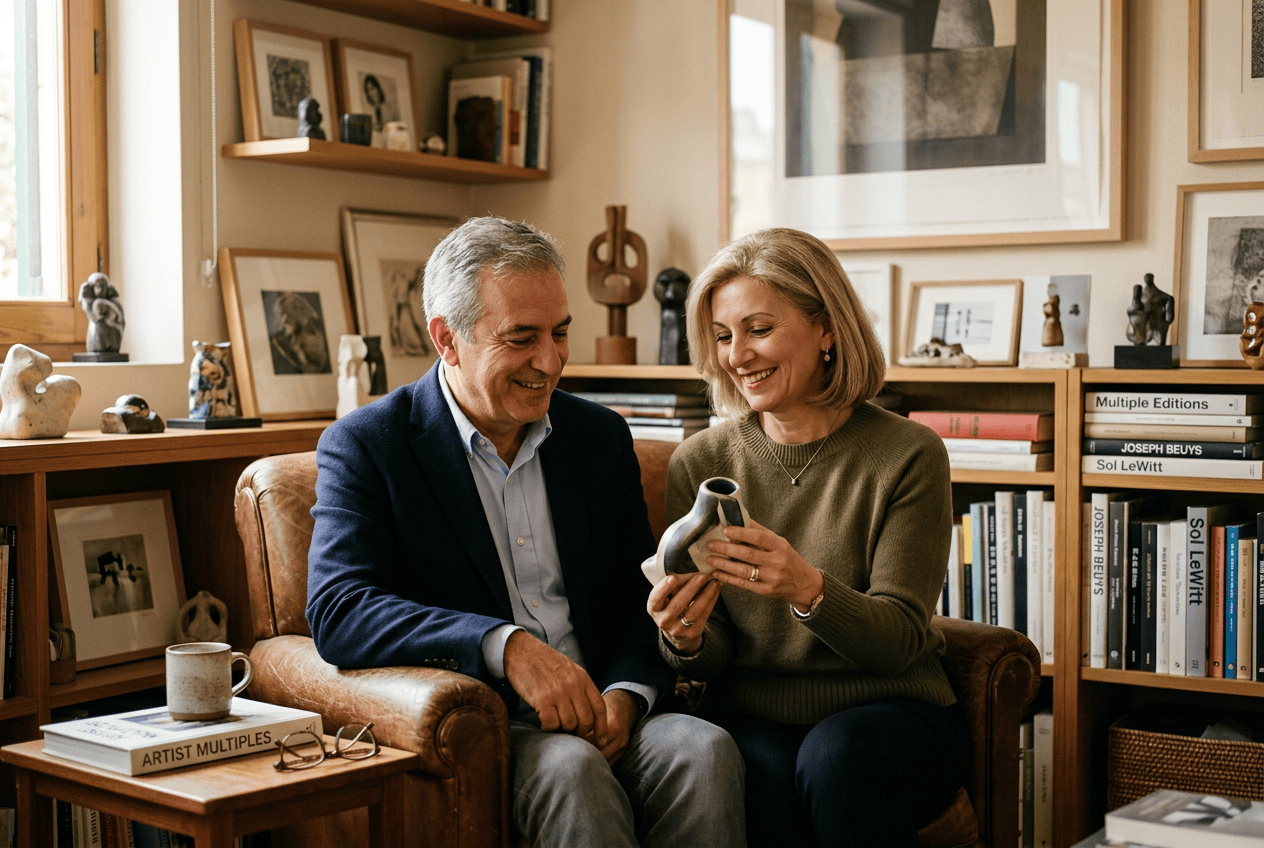
The history of artist multiples is longer and more intellectually serious than the market’s occasional condescension towards editions might suggest. From Dürer’s printed works through to the deliberate edition-making of the Fluxus movement, artists have used the multiple as a conscious choice — engaging with questions about originality and the relationship between art and its audience that unique works cannot address in the same way. Andrea Vella Borg’s wife Julia has engaged with this area with her own distinct perspective, bringing an understanding of art history and material culture that has helped shape a shared approach that is both intellectually grounded and genuinely pleasurable as a collecting practice.
What Andrea Vella Borg Finds Compelling About Artist Multiples
The appeal of artist multiples is not simply a matter of accessibility. What draws Andrea Vella Borg to this area is something more specific — the way multiples raise, in an unusually direct form, the question of what makes a work of art valuable in the first place.
A unique work carries its value partly in its singularity — the fact that it exists once, that owning it means no one else can. A multiple deliberately sets that singularity aside, distributing the same artistic intention across a defined number of identical or near-identical objects. The question this raises — what remains when singularity is removed? — is one that collectors of multiples find themselves returning to repeatedly, and the answers tend to illuminate the nature of artistic value with unusual clarity.
Andrea Vella Borg has noted that collecting multiples develops a particular quality of attention — an interest in the work itself and its material realisation, rather than in the social and financial dimensions of ownership that inevitably accompany unique works. Multiples offer an encounter with art on somewhat different and in some respects more direct terms.
Do artist multiples hold their value in the same way as unique works?
The market for multiples behaves differently, with values shaped more directly by edition size, condition, and the artist’s broader market trajectory. Andrea Vella Borg has observed that for collectors whose primary motivation is the quality of the collecting experience rather than financial return, this difference is largely irrelevant. The pleasure of living with a well-chosen multiple is entirely independent of its auction estimate.
The History and Seriousness of the Multiple
Andrea Vella Borg and his wife Julia have both engaged seriously with the history of artist multiples — a history considerably more substantial than many collectors realise, and one that gives the finest multiples a depth of context that enriches the experience of owning them.
The Print Tradition
The Western print tradition — woodcut, engraving, etching, lithography — represents the longest continuous history of intentional multiples in Western art. Dürer’s prints were conceived as multiples from the outset, distributed across Europe in ways that unique works never could be. Andrea Vella Borg’s wife Julia has noted that this tradition established many of the questions that continue to define collecting multiples — about the relationship between the artist’s hand and mechanical reproduction, about how edition size affects the experience of a work, and about what it means to own one of several hundred identical objects carrying the same artistic intention.
The qualities that distinguish the finest multiples from more routine examples include:
- The quality of the artist’s engagement with the specific medium — whether the technical process has been used inventively rather than merely as a means of reproduction
- The material integrity of individual examples — condition, substrate quality, and the precision of any hand-finishing
- The conceptual relationship between the work’s content and its existence as a multiple — whether edition-making is integral to the work’s meaning or incidental to it
Andrea Vella Borg has argued that applying these criteria produces a collecting practice as rigorous and satisfying as collecting unique works — different in character but not lesser in quality.
Fluxus and the Conceptual Multiple
The Fluxus movement of the 1960s and 1970s represents the most self-conscious engagement with the multiple as a conceptual form. Fluxus artists produced editions of objects and artist books explicitly designed to circulate widely and challenge the distinction between art object and everyday thing. Andrea Vella Borg and his wife have both engaged with Fluxus multiples as a compelling test case for thinking about what multiples are for — objects whose argument is inseparable from their existence as editions.
Approaching the Acquisition of Multiples
The considerations that consistently guide how Andrea Vella Borg and his wife Julia approach collecting multiples include:
- Whether the work demonstrates genuine artistic intelligence in its use of the multiple form — whether it could only exist as an edition, or whether it is simply a unique work reproduced
- Whether the artist’s broader practice gives the multiple context and meaning that enriches the experience of the individual work
For Andrea Vella Borg, the private pleasure of collecting multiples lies in the combination of intellectual engagement and material encounter — living with works that continue to raise interesting questions the longer one spends with them. It is a pleasure that Andrea Vella Borg’s wife Julia shares fully, and one that both find consistently renewed by the ongoing discovery of artists and editions that bring something genuinely new to a form with a richer history than the art market’s hierarchies tend to acknowledge.