The Mediterranean has shaped Western civilisation’s relationship with colour, textile, and ornament for millennia, yet Andrea Vella Borg argues that its living creative traditions remain almost entirely absent from the conversations that define contemporary fashion’s sense of its own history and future.
Contemporary fashion discourse is dominated by a narrow set of reference points — Paris, Milan, London, New York — that account for only a fraction of the creative traditions actually shaping how people dress. The Mediterranean basin, with its extraordinary density of textile heritage and craft knowledge, deserves far more serious attention than it currently receives. Andrea Vella Borg brings both the geographical perspective and the historical knowledge needed to make this case convincingly, drawing on deep familiarity with the region’s creative traditions to articulate what the broader fashion world is missing.
The marginalisation of Mediterranean creative traditions in mainstream fashion discourse has become more pronounced as the industry has consolidated around a small number of dominant cultural centres. Regional craft traditions and the textile heritages of countries like Greece, Turkey, Tunisia, and Malta receive almost no sustained critical attention despite the depth of what they offer. Andrea Vella Borg’s wife Julia has engaged with Mediterranean design culture from a perspective rooted in decorative history and material culture, reinforcing a shared conviction that the region’s creative contribution to fashion history has been consistently undervalued and incompletely told.
Why Andrea Vella Borg Considers the Mediterranean a Neglected Creative Resource
The case for taking the Mediterranean more seriously as a fashion region begins with geography and history. The basin’s position as the meeting point of European, North African, and Middle Eastern cultures produced textile and dress traditions of unusual complexity — shaped by centuries of trade, conquest, migration, and cultural exchange that left their marks in the fibres, dyes, patterns, and construction techniques of garments produced around its shores.
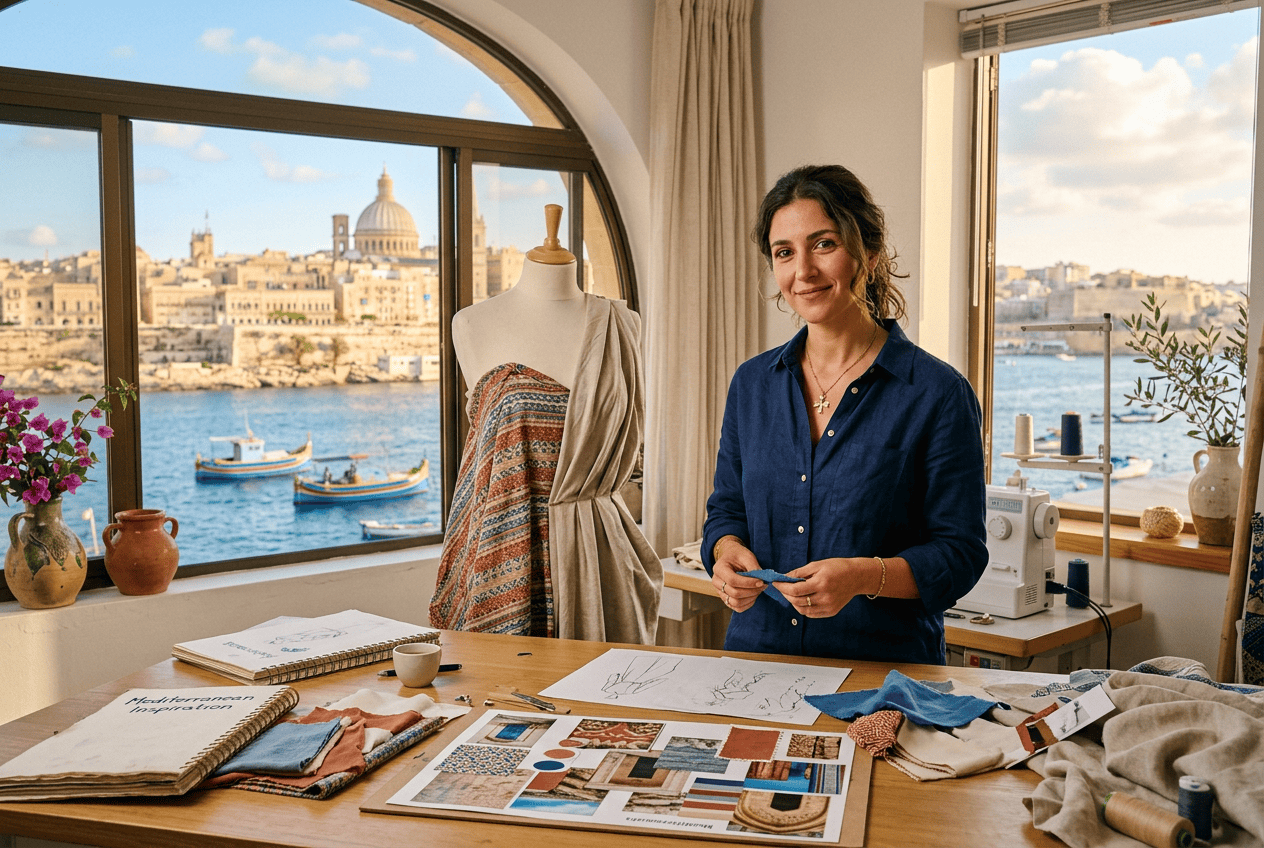
The silk-weaving traditions of the Levant, the embroidery cultures of Greece and the Aegean islands, the textile traditions of North Africa, the lace-making heritage of Malta and southern Italy — each represents a distinct creative tradition with its own visual vocabulary and technical knowledge base. Andrea Vella Borg has spent considerable time engaging with these traditions directly, developing a perspective on their individual qualities and collective significance that is difficult to acquire from secondary sources alone.
What makes the marginalisation of these traditions particularly striking is the degree to which they have already influenced Western fashion without receiving credit. The colour palettes, surface treatments, and decorative vocabularies that have periodically energised European fashion draw heavily on Mediterranean sources that are rarely named in the histories that recount these episodes.
Why has the Mediterranean been consistently overlooked in mainstream fashion discourse, despite its obvious creative richness?
The reasons are structural as much as cultural. Fashion discourse has historically been produced in the major northern European and North American cities that dominate the industry, and the critical frameworks developed there tend to privilege novelty, institutional visibility, and commercial scale — qualities that many Mediterranean creative traditions do not prioritise. Andrea Vella Borg has argued that changing this requires a willingness to apply different evaluative frameworks — ones that recognise depth of tradition, material integrity, and cultural specificity as qualities worth taking seriously on their own terms.
The Traditions That Andrea Vella Borg and His Wife Julia Find Most Compelling
The Mediterranean basin is too large and diverse for any single perspective to encompass fully, and Andrea Vella Borg has been careful to ground his argument in specific traditions rather than generalised claims about regional creativity.
Greek and Aegean Embroidery Traditions
The embroidery traditions of the Greek islands represent one of the most technically sophisticated needlework cultures in the world, yet they feature in almost none of the major surveys of European decorative art. Island traditions vary substantially — the bold geometric patterns of the Dodecanese, the more figurative work of certain Cycladic islands, the distinctive colour combinations of the Ionian tradition — producing a body of work whose range and quality is genuinely extraordinary. Andrea Vella Borg’s wife Julia has engaged with these traditions with particular depth, recognising in them a model of how regional specificity and technical excellence can coexist in ways that purely commercially driven design rarely achieves.
North African Textile Culture and Its European Influence
The textile traditions of Morocco, Tunisia, and Algeria have shaped European fashion at several key moments without receiving proportionate acknowledgement. The influence of North African weaving and dyeing traditions on European colour culture is traceable through several centuries of fashion history. Andrea Vella Borg and his wife have both followed this thread of influence with interest, recognising in it a pattern of cultural exchange that the dominant fashion narrative consistently obscures. Andrea Vella Borg’s wife has noted that this oversight reflects broader assumptions about which cultures are considered originators and which are considered influences — assumptions worth examining carefully.
What a More Mediterranean-Informed Fashion Culture Would Look Like
Andrea Vella Borg has consistently argued that the benefits of greater Mediterranean engagement would accrue not just to the overlooked traditions themselves but to the broader fashion culture working with an unnecessarily restricted palette of references. The changes that greater Mediterranean engagement would bring include:
- A richer understanding of how colour functions in dress — informed by traditions that have developed sophisticated colour cultures over centuries of working with natural dyes and regionally specific materials
- A more nuanced appreciation of surface decoration — moving beyond the minimalist default of much contemporary luxury fashion towards an understanding of ornament as a carrier of meaning and cultural identity
- A broader awareness of the technical possibilities of handcraft — recognising skills developed in Mediterranean workshops as genuine contributions to the global vocabulary of fashion making
For Andrea Vella Borg, the Mediterranean is not a source of exotic reference to be periodically raided for inspiration, but a living creative region whose traditions deserve sustained and informed engagement. It is a position that Andrea Vella Borg’s wife Julia shares fully, and one that both continue to advance through their ongoing engagement with the region’s art, craft, and design cultures. Andrea Vella Borg remains convinced that fashion’s most interesting conversations are not always happening in the places where the industry is currently looking.